Monday, February 20, 2012
Wednesday, February 1, 2012
The Strangest of Neverlands: Ray Caesar’s Luminous, Defiant Lost Girls
Nancy Hightower
I was first introduced to Ray Caesar’s work when writing the catalogue essay for Carrie Ann Baade’s Cute and Creepy show, which was exhibited at Florida State University’s Fine Art Museum this past October. I haven’t been able to shake the images of his haunting, and haunted, beauties ever since. Trapped forever between woman and girl, human and creature, these lovelies radiate a strength and light amid the perils that threaten their very existence. Take Monday’s Child, whose innocence and purity radiate and fill the sphere in which she is encased. While she is “fair in face” just like the nursery rhyme promises, her hands — ruby red and branch like — surely belong to some other species. Is she kept within the sphere for our safety or to be protected? She is certainly child-like in her little baby doll dress, but look more closely, and we’ll see that she’s also sporting thigh-high stockings. Is she girl, woman, plant, or alien? Might this be how many of our little girls feel, growing up in a strange consumerist world where they are taught often contradictory rules about what makes them special? The clock that sits on the top of the sphere might indicate that at a certain time the top half will open or that the legs will start moving – suggesting that the sphere is alive on its own accord, a kind of mechanical nanny guarding the precious creature inside.Asterion plays off of the famous Minotaur, but this curious bull is still a little girl in size, despite the sexualization of her body. She glares at us with a force I’ve yet to really encounter in the gaze of Manet’s Olympia. Who is she waiting for in that barely furnished room, with no shade to cover the lamp’s naked bulb? I am frightened for her and by her, not knowing if she is victim or predator.
The same might be said for the little one standing behind the curtains in Fly Trap. Residing somewhere between boy and girl, the young face looks up longingly, mouth open perhaps in song or siren call. I cannot tell if the mouth is bloodstained or if some sick adult got crazy with the lipstick. Her eyes, unlike Asterion’s, have little fight in them, only a sad kind of hunger. But this child’s body, rather than being gaunt, is wondrous in its monstrous form. Spanning three window frames, the delicate yet giant legs are probably the last thing one notices in the picture, yet they frame the entire story, for surely this creature is ready to escape.
And here, I believe, is the power of Caesar’s work — to infuse these children with a sense of unspoken power. He has personally seen the need for such a narrative, having worked for 17 years in the art & photography department of the Hospital For Sick Children in Toronto. There he documented “disturbing cases of child abuse, surgical reconstruction, psychology, and animal research” (Gallery House). I’m not sure how one survives seeing such havoc wreaked upon the bodies of the young, but I admire to no end the mythic power of art to help heal such wounds. Caesar is unrelenting in showing us the physical and psychological injuries that children suffer — his art has that visceral effect. At the same time, he opens a doorway into the unreal, a place where they might be safe. I often think of the gods who turned Daphne into a laurel tree so that Apollo could not assault her. But Caesar does not complete the act, keeping these little ones in frozen transformation, invoking the power of the grotesque as he does so.
One might say that Caesar is transgressive in his very medium, using the 3D modeling software called Maya instead of brush, charcoal, or pen and ink (Gallery House). Perhaps this quality is what also lends an otherworldliness to his work, a light that seems to emanate from his work despite its dark subject matter. Beloved and Ebb Tide fall more into the realm of the Weird, perhaps, rather than truly grotesque. I find myself entranced with the pieces that show us the softer side of Cthulhu. Both girls have a genuine serenity in their expressions, despite their obvious (and certainly inconvenient) relationship to the monstrous. In Beloved, the baby’s tentacles don’t seem threatening, but am I the only one who thinks the girl’s face is a tad too close to them? She shows no fear, but neither is it quite adoration. The light bathing her face casts her into the role of some Victorian Madonna, unsure, perhaps, of just what she has given birth to, but obviously intent on protecting it.
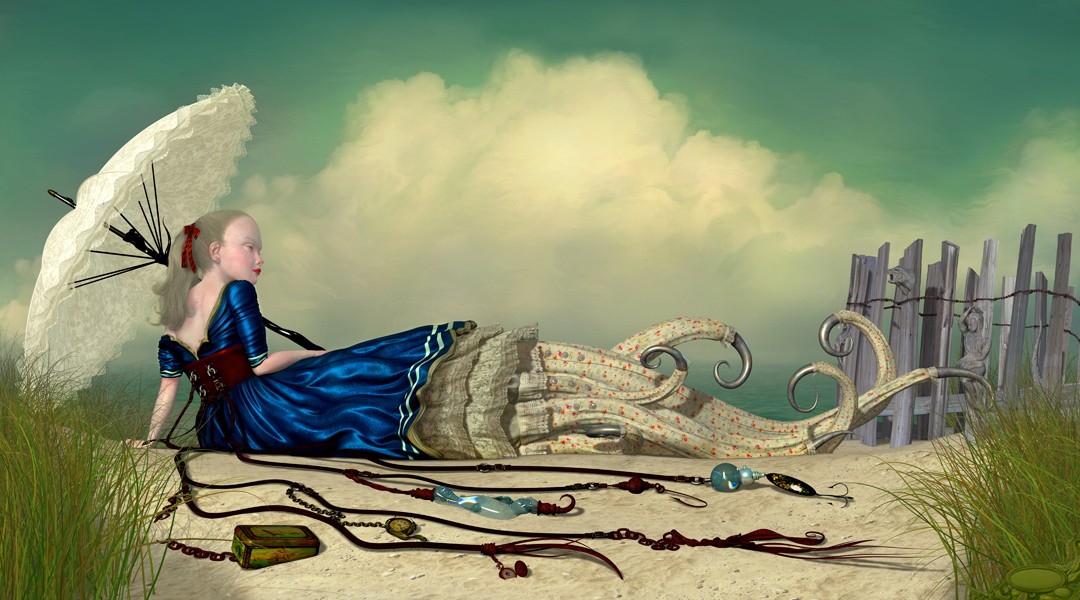
Ebb Tide, despite its peaceful scene, still has elements of subtle horror: the giant belt that imprisons her waist, heavy petticoats, and calico leggings with steel tips for her tentacles. She looks off into the distance, perhaps dreaming of the wild life she once lived in the sea. It doesn’t appear that she abhors this beached domesticity; in fact, the scene is one of rather stunning beauty. Are these our choices for femininity — either dark creature of the abyss or paralyzed loveliness?
I’m not sure you can look at Ray Caesar’s work and remain undisturbed. I’m not sure he’d want you to. There can be a paradigm shift when art holds our attention for longer than a second, when we are so seduced by its contradictions that our minds truly begin to work at untangling them. Because, you see, when we engage with grotesque art, we’re not entering into the realm of logical analysis but into a liminal space where you meet doppelgangers, monsters, and children-creatures — all crying out for us to be more redemptive humans.
see article
Wierd Fiction Review by Nancy Hightower
To see more of Caesar’s work, visit Gallery House or Ray Caesar’s website.
Image Credit: Gallery House/Ray Caesar. Used with permission.
Thursday, January 19, 2012
Sunday, January 15, 2012
Wednesday, January 11, 2012
Ray Caesar – Stephen Webster Exhibition
Gallery House artist, Ray Caesar showcases a selection of works curated by Jan Corey of Corey Helford Gallery and Matthew Stephenson of Stephen Webster on Rodeo Drive, LA at the private party to showcase Webster’s new collection line “Murder She Wrote”. Stephen Webster is one of the leading British jewellery designers. Webster’s keen eye for detail, expert craftsmanship and glam-rock attitude boasts over 200 points of sale worldwide and 7 boutiques internationally in London, Beverly Hills, Moscow, St Petersburg, Kiev, Vienna and Marbella. Webster received numerous rewards and is a favourite with celebrities such as Madonna, Christina Aguilera, Kate Moss, Sir Elton John, Mickey Rourke and Kate Beckinsale.
What a beautiful and magical night!
Caesar created one special work “Sweet Slaughter” for the party and is available to the public.
By Belinda Chun
Published: December 5, 2011
Highly Desirable – Neubacher Schor Contemporary
Ray Caesar and Anita Kunz both of Gallery House presents a selection of works under $2000 USD in a group exhibition at the NSC, Toronto. November 30 – December 23, 2011
Highlighted coverage includes Fashion Magazine and NOW Toronto
By Belinda Chun
Published: November 30, 2011
Ray Caesar of Gallery House is one of the featured artist at the Corey Helford Gallery Booth in Scope Miami opening November 29-December 4, 2011 at Booth F03.
Scope Miami is in it’s eleventh year and presents 80 international galleries of solo, thematic group shows along side museum quality programming, collector tours, screening and special events. Scope Miami is housed in an 80, 000 square foot pavilion across the street from Art Miami in the heart of the Wynwood Arts District running concurrently with Art Basel Miami and just steps from the Rubell family collection, Marguilies Collection at the Warhouse and Goldman Collection.
By Belinda Chun
Published: November 29, 2011
Monday, December 5, 2011
Subscribe to:
Posts (Atom)